
Analytics
Vincent Depassier · August 30, 2026
A published App reports its own traffic. There is no tag to install and no third-party account: a small script in the published site records each page view, and the App's analytics screens read it back.
What a page view records
Field | Notes |
Page | Which page was opened |
Visitor hash | An opaque value that groups a person's visits — not an identity |
Country, city, coordinates | Approximate, from the request |
Referrer | Where they came from |
User agent | Browser and device string |
Unique | Whether this is the visitor's first view today |
Duration | How long they stayed |
Duration arrives separately from the view itself. The script reports it when the page is hidden or closed, which means a visitor who closes their laptop lid mid-article may never send it. Treat a missing duration as unknown, not as zero.
What the screens show
View | Answers |
Stats | Totals: visits, unique visitors, today |
Hourly | Shape of a single day |
Daily | Trend over time |
Pages | Which pages get read |
Countries | Where visitors are |
Log | Individual visits, most recent first |
The log is the one to reach for when a number looks wrong. Aggregates hide the explanation; a list of individual visits usually contains it — a burst from one referrer, a crawler working through the site, a link that went out in an email.
What "unique" means here
Two different things use that word, and it is worth separating them:
A visit is marked unique when it is the first one from that visitor hash that day, counted in UTC.
The unique visitors total counts distinct hashes over the whole period.
The UTC boundary matters if your audience is in one timezone: their evening may fall on the next analytics day. A daily chart that looks shifted is usually this, not a bug.
Accuracy, honestly
This is lightweight measurement, not forensic accounting. Three things to keep in mind:
Location and device are approximate. They are derived from the request and can be reported by the client, so treat them as a rough shape of your audience rather than facts about individuals.
The visitor hash is not a person. Same browser, same device: one hash. A person on a phone and a laptop is two. Someone who clears their browser data becomes a new one.
Blockers exist. Some visitors' browsers will not run the script at all. Your real traffic is somewhat higher than what you see, consistently enough that trends stay meaningful even though absolute totals under-count.
Privacy
You are the one publishing the site, so the responsibility for what you tell visitors is yours. What this feature does and does not do makes that easier: page views, an opaque visitor hash, approximate location, no cross-site tracking, and no third party receiving your visitors' data.
If your jurisdiction requires a notice or a cookie banner for analytics, that requirement does not disappear because the analytics are built in — check what applies to you.
Next
Publishing and versions — how the site and its script get out
Pages and navigation — the head and body injection, if you also want a third-party tag
What it looks like

Read the small grey line under each number before the number itself — it tells you which window that figure covers, and they are not all the same window. Total visits and Unique visitors say all time: they ignore the period selector entirely. Avg / day says 30D, so it does move with the selector. Visits today is always today. This is the single most common misreading of the screen: changing the period from 30D to 7D leaves the two largest numbers untouched, which looks like a bug and is not.
Custom at the end of the selector opens a start and end date, for a window the presets do not cover.
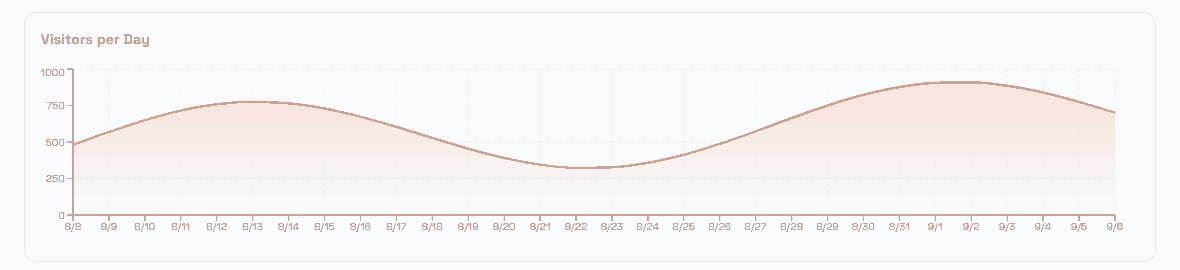
The chart is the part that answers questions the totals cannot: whether traffic is trending, and whether a spike lines up with something you did. It plots one point per day across the selected period, so switching to Today swaps it for an hourly view of the same data instead of a single flat point.